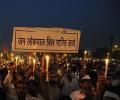
Aam Aadmi Party-led Delhi government is locked in a power struggle with the Centre and the Lt Governor. Kavita Chowdhury reports
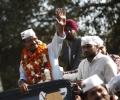
It is too early to say whether the Aam Aadmi Party's transformation from a watchdog of Indian politics to the lapdog of the political elite is complete. But it seems to be heading in that direction, says Bharat Bhushan

Days after the Aam Aadmi Party appointed a new Lokpal panel replacing him, former Navy chief Ramdas has questioned the decision, claiming his term was to end in November 2016.

Delhi Chief Minister Arvind Kejriwal's ailments are a "classic case" of faulty and stressful lifestyle but he has been "detoxified" to a large extent now, a senior doctor has said.

Former AAP leaders Yogendra Yadav and Prashant Bhushan said the Bill was completely different from the one envisaged originally.

Several former colleagues say Kejriwal is undemocratic. But his loyalists stand stoutly behind him

'You can never say never in politics.' 'We may still see the return of AAP, but hopefully not of the same abusive politics again,' says Shekhar Gupta.

Khetan, who did not deny the resignation, said he was not involved in "active politics at the moment" and was not interested in rumours.

Chief Minister Arvind Kejriwal flew back to Delhi on Monday night after 12 days of naturopathy treatment in Bengaluru for chronic cough and diabetes, raring to resume work in the government and in Aam Aadmi Party which is grappling with growing internal rift.

Delhi Chief Minister Arvind Kejriwal was on Thursday admitted to a naturopathy institute on the outskirts of Bengaluru for a 10-day nature cure regimen for treatment of his persistent chronic cough problem and uncontrolled sugar level.
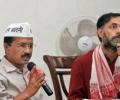
Amidst rumblings of a crisis within AAP, a letter by its internal Lokpal has pointed to the growth of two camps within the top leadership of the party due to an "abject breakdown in communication and mutual trust" and said it needs to make efforts to address criticisms over inner-party democracy.
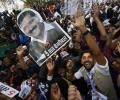
'I think the AAP is still in transition from being a movement to a political party so there is a mix of people who form the party. So there is somewhat of a overlapping and commonality of purpose.' 'Look at the way the government and party is functioning, not a single woman minister in the cabinet, or no woman member in the political affairs committee, it is all very tactical now.' 'After the 'sting' I decided to step back. I realised that my moral basis has been questioned by Kejriwal, it is truly despicable. He is around 15 years younger to me, I was aghast by his words.' AAP 'rebel' Prof Anand Kumar speaks of what went wrong with the party in the last few days in this interview with Upasna Pandey.
He calls himself a "political revolutionary" now, but Arvind Kejriwal says that he had never imagined that he would one day plunge into politics, form a party and contest elections.

Gandhi was in the eye of a storm for allegedly leaking defence secrets to controversial arms dealer Abhishek Verma.

2015 is finally coming to an end, and it is that time of the year when we collectively reflect on all that has transpired in Indian politics during the last 12 months.

Without doubt, the BJP is miles ahead in marshalling digital tools for electioneering better than any other party, observes Virendra Kapoor.
The Aam Aadmi Party has demanded the dismissal of Telecom Minister Ravi Shankar Prasad alleging a conflict of interest that has prevented him from issuing a notice to Mukesh Ambani's Reliance Jio on the 4G issue, a charge vehemently denied by Prasad who said he never gave advice or appeared for the company.
A party of newbies which had anger as fuel and hope in its own capability to work wonders suddenly finds itself not only in government but put on fast forward by everyone. These are heavy burdens for a fledgeling party, to perform under a microscope. Transparency is what they promised, and they are in a glass house now, says Mahesh Vijapurkar.

The man, who identified himself as 'Rambhakt Gopal', was subsequently overpowered by police and detained. The gunman went live on Facebook before the brandishing the gun.

AAP has been vociferous since its inception and has mainly raised issues pertaining to corruption. A political party must have crisp and specific standon all issues which concern the nation not just corruption or secularism; and AAP has failed to deliver on all these counts, says Aditya Shah and Aadit Kapadia.
As it completed an eventful 100 days in office, the Aam Aadmi Party government on Sunday mounted a blistering attack on Modi dispensation accusing it of making a "U-turn" on granting full statehood to Delhi and indicated tabling a resolution to reject the "unconstitutional" notification giving absolute powers to the Lt Governor.

Why are so many people so reluctant to give up on Arvind Kejriwal? The simple answer is 'Narendra Modi', or rather the fear of Narendra Modi,' says T V R Shenoy.

Should the party expand to Punjab, Bihar and other places, or should it consolidate its gains in Delhi? This was one of the questions before the party when it split sometime back. An answer is yet to emerge.
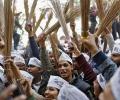
Now that the AAP has turned from an anti-corruption movement to a political party running a government in New Delhi, it may find that the media is no more a collaborator, says Mahesh Vijapurkar.

'Brand Kejriwal-AAP have a long way to go even if they win another Delhi election...'
'It is a force nobody can ignore, not even Mr Modi, because it will keep punching above its weight,' notes Shekhar Gupta.

Can un-democracy be the foundation for a democratic party that aspires to be different from all other parties in India.

Aam Aadmi Party on Wednesday came out with its manifesto for the December 4 Delhi polls, promising to enact Jan Lokpal Bill in 15 days if voted to power.

'Kejriwal's way of working is 'my way or the highway'. If you don't say Kejriwal zindabad then you will be thrown out of the party.' 'I feel Kejriwal is a very darpook (frightened) man. When he lost in the Lok Sabha elections his strength disappeared and he started compromising.' Aam Aadmi Party rebel Pankaj Pushkar speaks out.
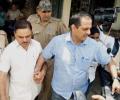
The fiasco over the former Delhi law minister's college degrees has damaged the reputation of the Aam Aadmi Party, says Nupur Sharma.

Honesty coupled with pragmatism translates to good governance. Honesty plus hubris and self-righteousness spells disaster: that is what the AAP is, says Vivek Gumaste

There is a vital difference between Bofors and Rafale, explains Shekhar Gupta.

'Drought in the 1990s was essentially the drought of a poor India.' 'This 2016 drought is of a richer and more water-guzzling India.' 'The severity and intensity of the drought is not about lack of rainfall.' 'It is about the lack of planning and foresight, and criminal neglect.'

'Swaraj Samvad sees itself in the role of a watchdog in Delhi,' Professor Anand Kumar tells Rediff.com.

Kapil Mishra was one of the closest aides of Delhi Chief Minister Arvind Kejriwal. However, in May 2017, the tides turned. A loyalist of the Aam Aadmi Party founder, Mishra shocked one and all by openly accusing him of corruption, a claim that the AAP dismissed. Since then Mishra has become one of the most prominent AAP rebels. In the face of the sit-in by Kejriwal, his deputy Manish Sisodia and ministers - Satyendar Jain and Gopal Rai at Lieutenant Governor Anil Baijal's office, Mishra spoke to Syed Firdaus Ashraf/Rediff.com and said that this is the first time in history that a sitting chief minister of a state in India has kidnapped himself.
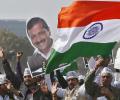
From his run-ins with the Centre to his political knack to sail through choppy waters, the Delhi CM has shown uncommon talent in running a 'common man's' government.
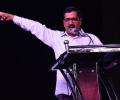
The street-fighter is back and the introspecting, sparingly speaking avatar of Kejriwal has gone on an extended recess. In this grime of heightened Delhi politics, all the good work done by the Delhi government may go down the drain, warns Sudhir Bisht.

'It is good for the country, but it is not good for a politician... What we call impatience is actually desperation to needing something NOW.' 'Our politics is restricted by one factor; that our Parliament is full of villages. 40% of the country now lives in cities but only 25% of Parliament is coming from the cities.'
 © 2026 Rediff.com - Advertise with us - Disclaimer - Privacy Policy - Sitemap - Feedback - About us - Terms of use - Grievances